Characteristics of Metallurgical Equipment and Bearing Requirements
Metallurgical equipment (such as rolling mills, continuous casting machines and converters) operates under extreme conditions involving high temperatures, heavy loads, impact loads and dust contamination over extended periods. This places stringent demands on bearings in terms of load-carrying capacity, self-aligning capability, high-temperature resistance and impact resistance. Thanks to their double-row symmetrical roller structure, self-aligning function and high radial load-carrying capacity, self-aligning roller bearings have become the preferred choice for core components in metallurgical equipment.
Key Application Scenarios and Solutions
1. Rolling Mill Systems
Application Areas: Work rolls, support rolls, and gearbox housings.
Operational Challenges:
Subject to enormous radial loads (with individual roll loads reaching hundreds of tonnes) and high-frequency impacts.
Generation of high temperatures during high-speed operation, requiring reliable support from the lubrication system.
Bearing Solutions:
Large self-aligning roller bearings: Manufactured from carburised steel or high-carbon chromium bearing steel (e.g. GCr15SiMn), with oxygen content reduced through vacuum degassing treatment, resulting in a fatigue life 1.8 times that of international standards.
Optimised Cage Design:
Split carbon steel cages replace traditional brass cages, with increased thickness to enhance load-carrying capacity.
The number of rollers is reduced to 20, their length shortened to 120 mm, and the cage web width increased to prevent rollers from falling out during assembly.
Movable Centre Rib Technology: Replacing fixed centre ribs, this allows axial movement, evenly distributes the load across the two rows of rollers, and prevents stress concentration.
Case Study: The main reducer on a hot rolling production line at a steel mill utilised optimised 241 series self-aligning roller bearings, extending service life from 4 months to over 1 year and reducing downtime costs by over 3 million yuan per year.
2. Continuous Casting Equipment
Application Areas: Ladle turntable, sector sections (curved section, straightening section, horizontal section).
Operational Challenges:
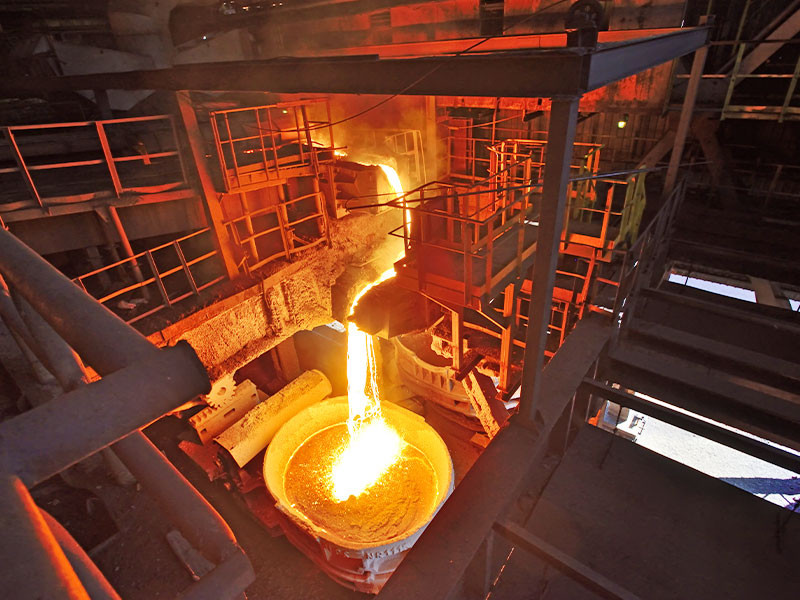
High-temperature molten steel comes into direct contact with the bearing housing, requiring a water-cooling system for temperature control.
High rolling forces cause significant thermal expansion of the rollers, resulting in slight misalignment of the bearing housing.
Bearing Solutions:
Specialised self-aligning roller bearings (e.g. 20000CC type, C0000 type circular roller bearings):
Dimensional accuracy consistently meets P6 grade, with rotational accuracy reaching P5 grade.
Reinforced steel cage design enhances oil retention capacity, making them suitable for high-temperature operating conditions.
Fixed centre flanges withstand axial forces, whilst the single-row self-aligning function compensates for installation misalignment.
Optimised sealing structure: labyrinth seals + lip seals, preventing the ingress of high-temperature steel billets, scale and cooling water.
Case study: Following the adoption of EISENBERG bearings in the sector section of a continuous casting machine, equipment failure rates were reduced by 40% and annual maintenance costs were cut by 2 million yuan.
3. Converter and Trunnion Systems
Application areas: Converter supports, trunnion bearings.
Operational Challenges:
Supporting the immense weight of the converter (hundreds of tonnes) and withstanding impact loads caused by frequent tilting.
Corrosion of bearing materials by high-temperature oxidising gases.
Bearing Solutions:
Split self-aligning roller bearings: facilitate installation and maintenance, and are suited to the converter trunnion structure.
Special Materials and Heat Treatment:
Bearing steel treated with a nano-composite coating, reducing the coefficient of friction to 0.002 and lowering temperature rise by 12°C.
Surface carburising and hardening treatment, achieving a roller surface hardness of HRC ≥ 60, with impact resistance improved by 40%.
Forced Lubrication System: An annular oil groove design on the outer ring, combined with independent oil supply lines, ensures a reliable supply of lubricant.