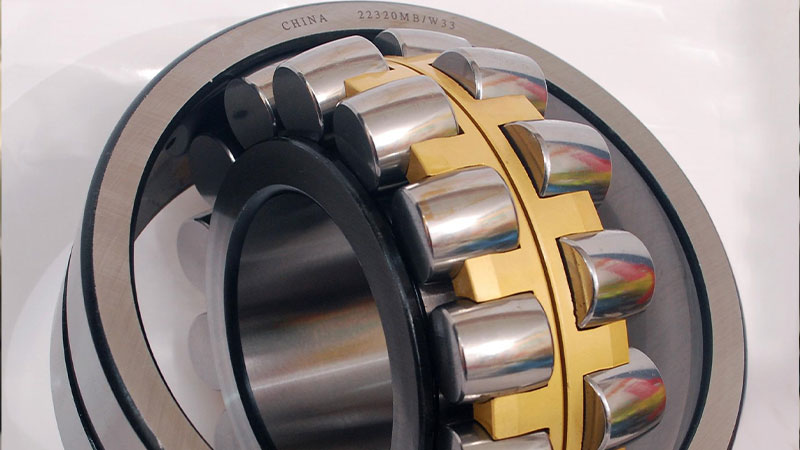
What are the key points to bear in mind when operating self-aligning roller bearings
The preload of self-aligning roller bearings is set at room temperature; however, under operating conditions, the temperature of the driven shaft rises due to slight stretching within the system, causing the bearing preload to change. Therefore, this factor must be taken into account when setting the preload.
The preload of self-aligning roller bearings must be set appropriately, taking into account load, speed and other conditions, to ensure the service life of the transmission. If the preload is too high, it may lead to excessive power consumption and even overheating. If the preload is too low, the load on the bearing, combined with the gap between the shaft and the outer ring, may cause runout and vibration, reducing transmission precision, increasing noise, and adversely affecting gear meshing, which can severely damage the teeth and bearings.
Depending on the specific self-aligning roller bearing assembly, methods such as directly rotating the preload nut to axially compress the inner ring of the bearing can be employed to eliminate the gap between the inner and outer rings, thereby achieving the desired preload. A common practice is to tighten the preload nut well beyond the required preload, then back it off by a quarter turn. Assembly Method: The advantage of this method is that it requires minimal investment, is simple and practical, and can be used for tapered roller bearings provided they are of consistent, high quality.
1.Electric Heating Plate Method
Place the bearing on an electric heating plate set to 100°C for a few minutes. This method is the simplest; turning the bearing over a few times ensures even heating, and it is highly efficient. It can be used for both small and large self-aligning roller bearings.
2.Electric furnace heating method
Place the bearing in a sealed, automatically temperature-controlled electric furnace for heating. This method ensures even heating, accurate temperature control and rapid heating, making it suitable for heating large batches of bearings.
3.Induction Heating Method
An induction heater can be used to heat self-aligning roller bearings to the required temperature quickly, reliably and cleanly. This is particularly suitable for applications where the inner ring has a tight fit. As only the inner ring is heated and the outer ring receives very little heat, the bearing can be mounted more easily onto the shaft and fitted into the housing bore.
4.Electric Bulb Heating Method
Using a 50W electric bulb to heat self-aligning roller bearings ensures a heating temperature of approximately 100°C. Smaller bearings can be placed directly on the bulb, whilst larger bearings can be placed inside the bulb’s conical cover. The conical cover prevents heat loss from the bulb and ensures uniform heating. The cover can be adjusted vertically, allowing it to accommodate bearings of different sizes within a certain range. If a far-infrared bulb is used, ensure the bulb is directed downwards to avoid the infrared rays being harmful to the eyes. This method is suitable for heating small quantities of bearings that are not frequently required; where bearings need to be heated occasionally. The bulb can also be used for general lighting at other times, and no other equipment is required.
5.Oil Bath Heating Method
This is a widely used traditional heating method. A metal mesh is placed 50–70 mm above the bottom of the oil bath, with the bearings placed on the mesh. Large bearings should be suspended using hooks; bearings should not be placed directly on the bottom of the bath to prevent localised overheating of the bearing parts in contact with the bottom, or the ingress of sediment from the bath bottom into the bearings. Key points to note for the oil bath heating method are as follows: A non-corrosive mineral oil with good thermal stability should be used; transformer oil is preferable. Both the oil and the container must be kept clean. The capacity of the oil bath should be determined by the size of the self-aligning roller bearing to be heated and the required oil volume. If the container is too small, the oil temperature will drop rapidly as soon as the bearing is placed in it during continuous operation, resulting in poor performance.